




CDD Fees in Venice and Wellen Park: What Buyers Need to Verify Before They Offer

Luxury Homes By Carol Blog
What are CDD fees when you buy a home in Venice or Wellen Park? A CDD fee is an assessment from a Community Development District that shows up on your annual Sarasota County or Charlotte County property tax bill, not on your HOA statement. It is separate from your property taxes and your HOA dues, and you have to verify the amount parcel by parcel.
You found the house. The price works, the lanai faces the right direction, and you are ready to write the offer. Then somebody mentions a CDD, and suddenly there is a number nobody has shown you yet.
This is the single most common cost surprise I see with buyers moving to Venice, Englewood, and Wellen Park from out of state. It is not because anyone is hiding anything. It is because a CDD assessment lives in a different place than every other housing cost you have ever budgeted for, and most buyers do not know to go look for it.
Here is what a CDD actually is, why it lands on your tax bill, which communities around Venice and Englewood have one, and the exact steps to confirm the real number for the specific parcel you want before you sign anything.
What a CDD actually is
A Community Development District is a unit of local government created under Chapter 190 of the Florida Statutes. Think of it as a small special-purpose government that covers one master-planned community.
Here is the problem a CDD solves. Somebody has to pay for the roads, the water and sewer lines, the stormwater ponds, the streetlights, the entry features, and the amenity center before the first home is ever sold. That is a large bill, and it arrives years before there are any residents to share it.
Instead of the developer carrying all of that cost upfront and folding it into your purchase price, the district can issue bonds and spread the cost over decades. Every home inside the district then pays a share of the bond back through an annual assessment.
So the money is not disappearing. You are paying for infrastructure either way. A CDD just changes when you pay and how it appears.
Most CDD assessments have two parts
This distinction matters a lot, and almost nobody explains it to buyers.
The first part is debt service. That is your share of the bonds that built the community. It has an end date, because bonds get paid off. Depending on the community and which bond series covers your parcel, that could be years away or decades away.
The second part is operations and maintenance, usually shortened to O and M. That pays to keep the district running. It does not go away when the bonds are retired, and it gets set fresh every year by the district's governing board.
When somebody tells you a CDD "goes away eventually," they are talking about the debt piece. Ask which part of the assessment is debt and which part is O and M. It changes what your long-term carrying cost really looks like.
Why the CDD shows up on your tax bill instead of your HOA statement
Your HOA bills you directly, usually monthly or quarterly. Your CDD does not work that way at all.
In Florida, your real estate tax bill is a combined notice. It carries ad valorem taxes, which are based on your property's assessed value, plus non-ad valorem assessments, which are not. The Sarasota County Tax Collector explains that non-ad valorem assessments are based on a unit of measure set by each levying authority rather than on value, and that the levying authorities certify their assessments to the Tax Collector, who merges both rolls and mails you one bill.
A CDD is one of those levying authorities. So your CDD assessment arrives bundled into the same November tax bill as your county taxes, your fire district assessment, and your solid waste assessment.
That has three practical consequences for you as a buyer.
First, if your lender escrows your taxes, your CDD gets escrowed too. It is part of that monthly escrow payment, which means it is part of your qualifying payment.
Second, the assessment period does not have to match the calendar year, and it varies by authority. Do not assume the number you are quoted lines up neatly with your closing date.
Third, and this is the one that catches people, the amount is set annually by the district's board. It is not fixed for the life of your ownership the way a bond payoff schedule might suggest.
The disclosure law protects the first buyer, not always you
Florida does require a disclosure. Under Florida Statute 190.048, every contract for the initial sale of a parcel or a residential unit inside a district has to carry a specific notice in boldfaced type, larger than the surrounding contract text, immediately above where you sign. The required language says the district may impose and levy taxes or assessments on the property, that those assessments pay construction, operation, and maintenance costs of district facilities, that they are set annually by the governing board, and that they are in addition to county and other local taxes.
Read that word again: initial. The statute is written around the first sale.
If you are buying new construction directly from a builder in a district, you should see that boldfaced notice in your contract. If you are buying a resale from a private seller two streets over in the same community, that specific statutory notice is not necessarily sitting in your contract at all.
So on a resale, the burden of finding the number lands on you and your agent. That is exactly why I run this check before we write an offer, not after.
Which communities around Venice and Englewood have a CDD
You do not have to guess at this, and you should not take a listing agent's word for it either. Sarasota County publishes its own list.
The Sarasota County Property Appraiser's page on non-ad valorem and special assessment districts names the Community Development Districts operating in the county, along with a contact number for each one. As of the county's current published list, that includes Sarasota National CDD, Stoneybrook at Venice CDD, Toscana Isles CDD, Laurel Road CDD, Venetian CDD, Esplanade at Wellen Park, Blackburn Creek CDD, Bobcat Trail CDD, Central Parc CDD, Gracewater Sarasota CDD, Lakeside Plantation CDD, LT Ranch CDD, Myakka Ranch CDD, Rustic Oaks CDD, Three Rivers, The Woodlands CDD, Windward at LWR CDD, and the LWR Stewardship District.
If you are shopping Venice and you recognize a community name on that list, assume there is an assessment and go confirm the amount for your parcel.
And here is the detail I have never seen another local blog mention. The Property Appraiser's own page states that in Sarasota County, not all non-ad valorem or special assessment districts choose to use the TRIM Notice, so additional assessments may appear on your tax bill that were not on that August notice.
Translation: the TRIM Notice is a useful document, but it is not a guaranteed complete list of what you will owe. Treat it as one source, not the final word.
Wellen Park works a little differently
Buyers ask me about Wellen Park more than anywhere else right now, and its structure confuses people for a good reason.
Wellen Park is a large master-planned area with many separate villages, multiple builders, and multiple product types. It is not one single district with one single number. The county's list shows the West Villages Improvement District as an independent district, and separately shows Esplanade at Wellen Park among the Community Development Districts.
Different phases were financed at different times. That means two homes that look almost identical, built by the same builder, a few streets apart, can carry meaningfully different assessments because they sit in different districts or under different bond series.
So "what is the CDD in Wellen Park" does not have one answer. It has a per-parcel answer. Ask about the address, never about the community.
The Englewood and Charlotte County side
Englewood 34223 straddles the Sarasota and Charlotte county line, which means where your parcel sits determines which county bills you.
If your home falls on the Charlotte County side, your assessments come through the Charlotte County Tax Collector, on a bill mailed around November 1 each year, and Charlotte County has its own set of levying authorities. Checking the Sarasota list for a Charlotte County parcel will tell you nothing useful.
On the Sarasota side of Englewood, you will also see the Englewood Area Fire Control District and the Englewood Water District as independent districts with their own non-ad valorem assessments. Those are not CDDs, but they land on the same bill and they are part of your real monthly cost.
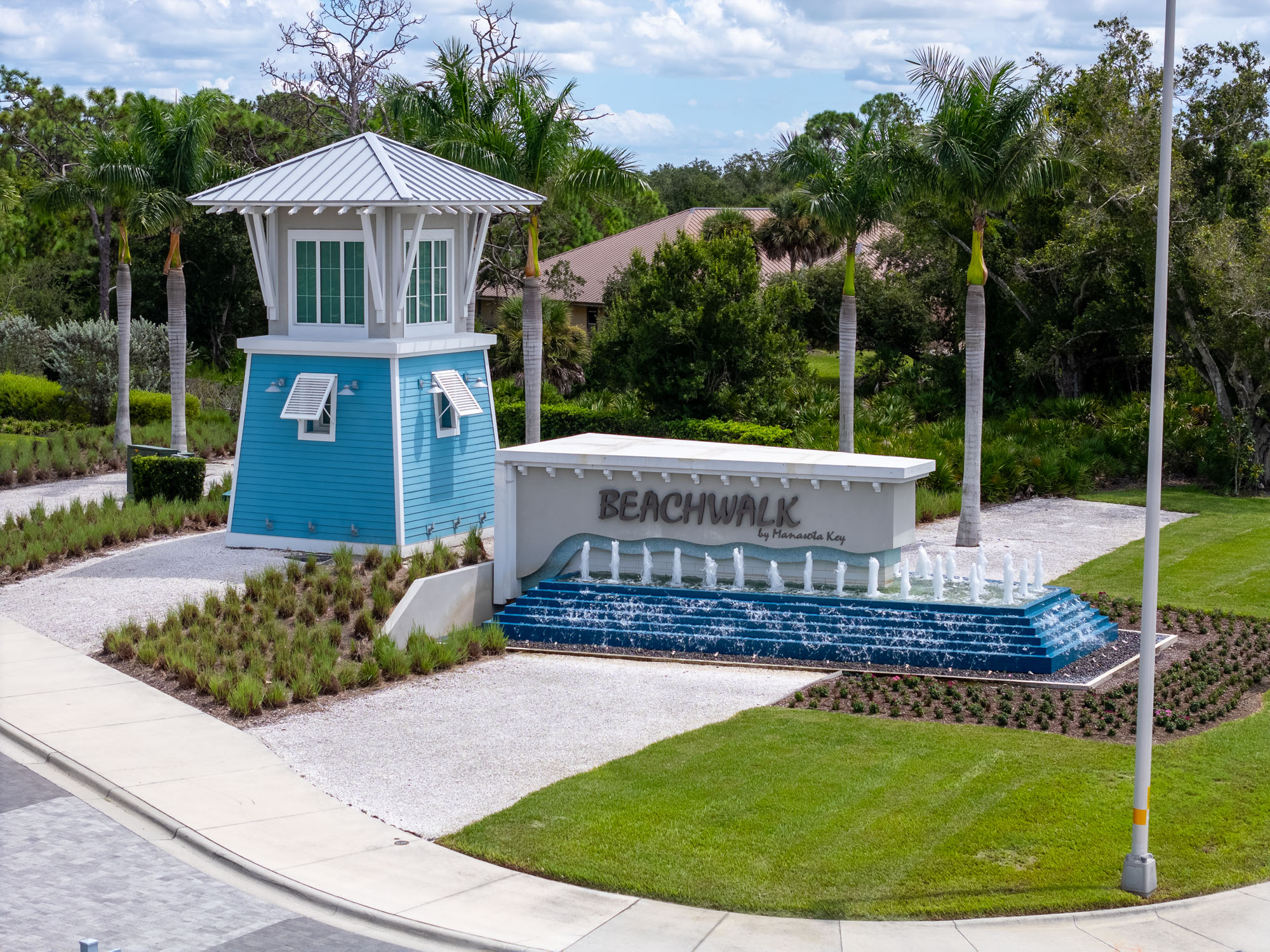
Beachwalk by Manasota Key is the community I sell most, and it does not carry a CDD. That is why you see NO CDD FEES in my listings there. It is a genuine cost difference and it is worth understanding what it does and does not buy you, which I get to below.
How a CDD can quietly break your loan approval
This is the part that costs people their deal, so I want to be specific about the mechanism.
Your lender qualifies you on a total monthly payment. Principal, interest, taxes, insurance, and HOA dues. Because your CDD assessment rides along on your tax bill, it flows into the tax portion of that calculation.
Here is an illustration, using round numbers purely to show the math and not as a quote for any actual community. If a parcel carries a $2,400 annual CDD assessment, that is $200 a month added to your escrow. On a pre-approval that was already close to the ceiling, $200 a month can be the difference between approved and not approved.
Now stack the real picture. Your county taxes, your CDD assessment, your fire and solid waste assessments, your HOA dues, your homeowners insurance, and flood insurance if the parcel needs it. Each one is reasonable on its own. Together they decide whether the home you love is actually the home you can carry.
The fix is boring and it works. Get the parcel-specific assessment number early, hand it to your lender, and have them run the qualifying payment with that figure included. Not an estimate. The number.
How to verify the real number before you write an offer
Five steps. This is the order I work in.
1. Pull the parcel on the county property appraiser's site. Search the address, then look at the non-ad valorem section rather than just the assessed value. Sarasota County and Charlotte County each have their own search. Use the one that matches where the parcel actually sits.
2. Look at the most recent actual tax bill, not just the TRIM Notice. The bill is the document that shows what was really levied. Remember that the Property Appraiser warns that not every district uses the TRIM Notice, so the bill can show assessments the notice did not.
3. Call the district directly. Both the Tax Collector and the Property Appraiser publish a phone number and email for each levying authority. The district's own office can tell you the current assessment for that parcel, how it splits between debt service and operations, and roughly how long the debt piece runs.
4. Ask whether the bond can be paid off, and whether the seller already did. Some districts allow a prepayment of the debt portion. If a prior owner paid theirs off, that parcel's assessment looks different from the house next door. That is a real and verifiable difference in your carrying cost, and it is worth asking about in writing.
5. Ask about any one-time charge at closing. Separate from the annual assessment, some communities have a capital contribution or initiation charge that appears on your closing disclosure. Confirm it before you budget your cash to close, not the week of.
If you want help running this on a specific address, that is a normal part of what I do on the buying side. Send me the address and I will pull it.
Should you just avoid CDD communities?
Short answer: no, not as a rule. Compare the total, not the label.
A community with no CDD is not automatically cheaper. That infrastructure still got paid for somehow, and it may sit in a higher purchase price or in higher HOA dues instead. I have watched buyers walk away from a home with a moderate CDD and a low HOA, then go buy one with no CDD and a much higher monthly HOA, and end up paying more per year.
What a CDD does give you is a fixed, public, documented number you can look up. A district's assessments are set in public budget meetings, and the district has to publish contact information. Compared to trying to forecast where an HOA's dues go after the next reserve study, that transparency has value.
So run the real comparison on any two homes you are weighing. Annual CDD assessment, plus annual HOA dues, plus estimated county taxes at your purchase price, plus your insurance quotes. One number against one number.
That is the comparison that tells you which home is actually less expensive to own, and it is almost never the comparison buyers are making when they call me.
Questions to ask before you sign
Bring these to the builder's sales office or to the listing agent, and get the answers in writing.
- Which district or districts levy assessments on this exact parcel?
- What was the total assessment on last year's tax bill for this parcel?
- How much of that is debt service and how much is operations and maintenance?
- What year is the debt portion currently scheduled to be retired?
- Has the debt portion been prepaid on this parcel?
- Is there a one-time capital contribution or initiation charge at closing?
- Are there any additional assessments on the bill that did not appear on the TRIM Notice?
- Has the district discussed any new bond issuance for future phases?
That last one matters in a community still building out. A district that is not finished may not be finished borrowing.
Frequently asked questions
Are CDD fees tax deductible?
This is a question for your tax professional, and the answer depends on how your specific assessment is structured and on your own situation. In general, tax treatment of non-ad valorem assessments is different from the treatment of ad valorem property taxes, and the debt and operations portions are not necessarily treated the same way. Get the assessment detail from the district and take it to your CPA before you assume anything.
Can I refuse to pay a CDD assessment?
No. It is levied by a unit of local government and collected on your property tax bill alongside your county taxes. Not paying it is not paying your property taxes, which in Florida leads down the delinquent tax and tax certificate road. If the amount does not work for your budget, that is a reason to choose a different parcel, not a bill you can opt out of later.
Do CDD fees ever go away?
The debt service portion has a scheduled end, because it is paying off bonds. The operations and maintenance portion does not, since it funds the district's ongoing costs and is reset by the board each year. Ask the district for the current split and the scheduled retirement year for the debt piece, and remember that a district still building out may issue new bonds.
How do I find out if a Venice or Englewood home has a CDD before I tour it?
Start with the county. Sarasota County's Property Appraiser publishes a list of the Community Development Districts and special assessment districts operating in the county with contact details for each, and the Tax Collector publishes the levying authorities and their assessment periods. For a Charlotte County parcel, go to Charlotte County's own records instead. Then confirm the parcel-specific dollar amount with the district itself, since assessments vary inside the same community.
Does a CDD affect what I can sell the home for later?
A buyer looking at your home will run the same total-cost math you are running now, so the assessment is part of how your home competes. That is a reason to know the number and be able to explain it, including what the district built with the money. It is not a reason to rule out a community, and I am not going to predict what any home will be worth down the road.
Let's get the real number on your address
CDD assessments are not a reason to be scared of Venice, Englewood, or Wellen Park. They are a reason to do ten minutes of homework before you fall in love with a floor plan.
If you are shopping right now and want the parcel-specific assessment, the HOA dues, and an honest total cost of ownership on a home before you write an offer, send me the address. I pull the county records and the district numbers on every home my buyers consider, and I would rather find a surprise now than the week before closing.
Get in touch here and tell me what you are looking at.
Have a great day!
Carol Burdelik
Luxury Realtor • ADTV Host • Coastal Lifestyle Expert
LPT Realty, LLC • License SL3549489
Serving Venice, Englewood, Wellen Park, Beachwalk by Manasota Key, Nokomis, Osprey, North Port, and Sarasota County
Carol Burdelik is a licensed Florida Sales Associate, not a CPA, attorney, or insurance agent. Nothing in this post is tax, legal, or insurance advice. Assessment amounts, district boundaries, and bond schedules change, so always confirm current figures with the county and the district for the specific parcel before you make a decision.
Communities
Featured Articles
Trending Articles from Southwest Florida’s Top Real Estate Team
Stay updated with our most popular real estate and luxury lifestyle articles.

Client Feedback
Read what previous homeowners have said about working with us.

Let's Connect
Get in Touch
We’re here to assist you with your real estate needs.
Say Hello
Reach out to us anytime.

Office
Luxury Homes by Carol
26040 Seastone Dr.
Englewood, FL 34223

Pushing You Forward
Our Team
Meet the dedicated professionals behind your real estate journey.


@CarolBurdelik on YouTube
Latest Youtube Videos
Get the latest videos by Carol Burdelik on her YouTube channel.
Get Started
Start Your Luxury Property Journey Today
Contact Carol for a personalized consultation and discover your dream waterfront property in Florida.